
Osteopathy vs physiotherapy explained for Calgary: philosophy, training, Alberta regulation, evidence, insurance and when to choose each, from Vitality BioMed.
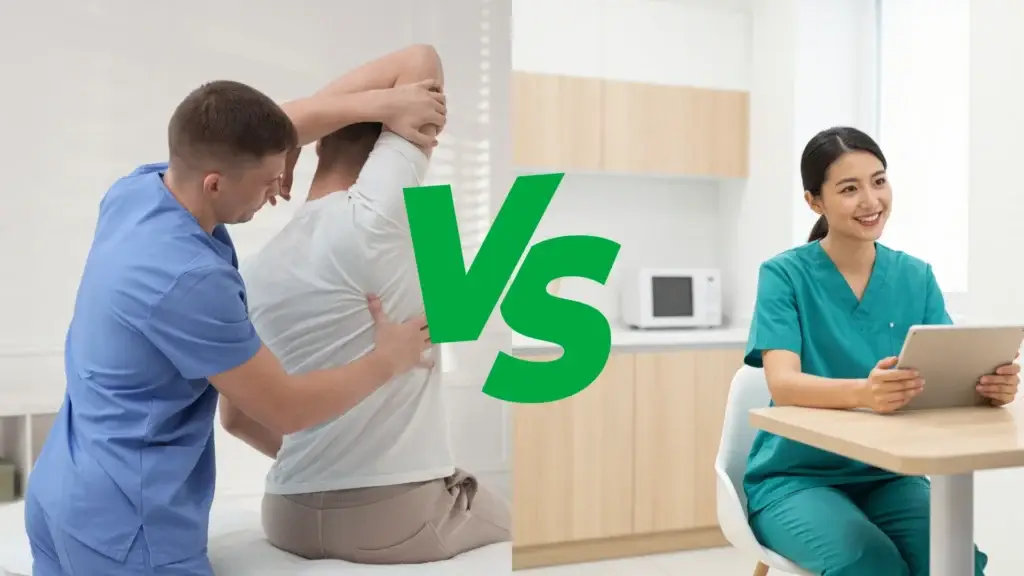
Back pain, a stiff neck, a shoulder that will not loosen up: sooner or later you may wonder whether to see a manual osteopath or a physiotherapist. The two professions overlap in what they treat but differ in philosophy, training, regulation and how a session feels. Here is how they compare, and how manual osteopathy fits into the integrative care we offer at our clinic.
Table of Contents
The short answer
Osteopathy is a hands-on, whole-body manual therapy. The practitioner uses palpation to find restrictions in muscles, joints, fascia and connective tissue, then applies gentle manual techniques to restore mobility and support the body’s own capacity to recover. Physiotherapy is a regulated health profession built around movement science: assessment of how you move and function, followed by a rehabilitation plan that leans heavily on prescribed exercise, with manual therapy and modalities as adjuncts.
Put simply, osteopathy is mostly done to you on the table; physiotherapy is mostly done with your therapist and then on your own. Many people benefit from both.
What is osteopathy?
The World Health Organization’s Benchmarks for Training in Osteopathy describe it as an approach that “relies on manual contact for diagnosis and treatment,” with emphasis on the body’s structural and functional integrity and its intrinsic tendency toward self-healing. The WHO calls for at least 1,000 hours of supervised clinical practice in training programs, and recognizes two pathways: Type I for new entrants, and Type II for people who already hold a health-care qualification.
In Canada, it is important to know that “osteopath” can mean two different things. Osteopathic physicians (DOs) are medical doctors trained in the United States and licensed by provincial colleges of physicians; there are very few in Canada. Manual osteopaths, the practitioners you will most often find in Calgary clinics, provide hands-on assessment and treatment of the musculoskeletal system but do not diagnose disease, prescribe, order imaging or perform surgery, as the Association of Manual Osteopaths of Canada explains. Alberta’s physicians regulation reserves titles such as “osteopath” for medically trained osteopathic physicians, which is why non-physician practitioners here use “manual osteopath” or “osteopathic manual therapist.”
Typical osteopathic techniques include soft-tissue work, myofascial release, muscle energy techniques, joint articulation, craniosacral approaches and visceral manipulation (gentle work on the mobility of organs and surrounding tissues). We have written separately about what visceral manipulation involves.
What is physiotherapy?
Physiotherapy applies movement science to restore function. In Alberta, entry-level physiotherapists complete a Master of Science in Physical Therapy (the University of Alberta is the provincial program) and must register with the College of Physiotherapists of Alberta under the Health Professions Act. The College keeps a public directory for verifying any physiotherapist, enforces standards of practice and runs a statutory complaints process.
A physiotherapy plan usually combines individually prescribed exercise and progressive loading, functional training, education and self-management strategies, plus manual therapy and electrophysical modalities where indicated. Physiotherapists also work across neurological, cardiorespiratory and post-surgical rehabilitation; Alberta Health Services funds physiotherapy for eligible patients after hip and knee replacement and certain other orthopedic procedures.
Osteopathy vs physiotherapy: the key differences
1. Regulation in Alberta
This is the most practical distinction. Physiotherapy is a regulated profession with a provincial college. Manual osteopathy is not regulated by a health college in Alberta; standards are set by voluntary professional associations such as the Alberta Association of Osteopathic Manual Therapists. New Brunswick became the first province to regulate osteopathy by statute in June 2025, but no equivalent legislation exists in Alberta as of this writing. In practice, you should check a manual osteopath’s training hours and association membership yourself, because no government body does it for you.
2. Approach to the body
Osteopaths start from the premise that structure and function are interrelated, so a restriction in one region (say, the diaphragm or pelvis) can drive symptoms elsewhere; treatment is global rather than local. Physiotherapy more often targets the specific tissue, joint or movement pattern identified as the problem, with measurable goals such as range of motion, strength or return to sport.
3. Passive versus active
An osteopathic session centres on hands-on treatment while you lie on the table, often with posture, breathing or movement advice to take home. A physiotherapy session centres on prescribed exercise and progressive loading: you move, load and practise, and you leave with homework. Neither is inherently better; they suit different stages of recovery.
4. Evidence base
Both have research behind them, with caveats. A 2022 overview of systematic reviews in BMJ Open found osteopathic manipulative treatment more effective than comparators at reducing pain and improving function in non-specific low back pain, chronic neck pain and chronic non-cancer pain, while rating the methodological quality of the underlying reviews as low. For physiotherapy’s core tool, a 2021 Cochrane review of 249 trials found moderate-certainty evidence that exercise therapy reduces chronic low back pain compared with no treatment, usual care or placebo, with an average 15-point improvement on a 100-point pain scale. Notably, the same review found no difference between exercise and manual therapy, which supports the view that hands-on and movement-based care are complementary rather than competing.
5. Cost and insurance
Outside publicly funded physiotherapy programs, both are typically paid out of pocket or through extended health benefits. Plans differ: physiotherapy is a common benefit, and AMOC notes that some private plans also cover manual osteopathy, sometimes conditional on association membership. One quirk worth knowing: because manual osteopathy is unregulated, the Canada Revenue Agency treats it as subject to GST/HST, unlike physiotherapy, which is exempt. Check your benefits booklet before booking either.
When to choose osteopathy
- Persistent pain or stiffness in the back, neck or joints
- Tension patterns that seem connected (for example, jaw, neck and shoulder together)
- Post-surgical restriction or scar-tissue tightness
- A preference for gentle, hands-on treatment and a whole-body assessment
When to choose physiotherapy
- Acute injuries such as sprains, strains and fractures needing a structured rehab timeline
- Post-operative rehabilitation after joint replacement or ligament repair
- Return-to-sport or return-to-work planning with measurable milestones
- A need for a regulated or publicly funded provider
How Vitality BioMed approaches manual osteopathy
At our Macleod Trail clinic, manual osteopathy is delivered by Blaine Skleryk, CCSE, DMO, RMT, M.Sc., B.Sc., a manual osteopath, remedial massage therapist and clinical somatic educator whose focus includes low-back pain, sciatica, TMJ, shoulder dysfunction and sports injuries. Rather than treating it as a stand-alone passive therapy, Blaine pairs hands-on work with laser therapy, somatic movement education and myofascial release, and sends patients home with exercises where appropriate: manual correction on the table, active retraining off it.
Hands-on treatment also sits inside a broader toolkit. Depending on what an assessment reveals, our team may add PEMF therapy or red and near-infrared light therapy for inflammation and tissue recovery, acupuncture for pain, or lymphatic drainage with our registered massage therapists. Our naturopathic doctors and functional-medicine physician can also investigate whether nutrition, hormones or systemic inflammation are keeping a musculoskeletal problem from resolving, the root-cause lens behind our approach to care.
We do not offer physiotherapy. If your situation calls for a regulated physiotherapist, such as early post-operative rehab, we will tell you, and manual osteopathy can run alongside that program rather than replace it.
Frequently asked questions
Can I see a manual osteopath and a physiotherapist at the same time?
Yes. A common arrangement is osteopathic treatment for pain relief and mobility, and physiotherapy for progressive strengthening and function. Let each practitioner know about the other so goals and timing are coordinated.
Do I need a referral for osteopathy in Calgary?
No. Vitality BioMed does not require a referral for manual osteopathy; confirm any reimbursement requirements with your insurer.
Is osteopathy safe?
Manual osteopathy uses gentle, low-force techniques, and most of the systematic reviews in the BMJ Open overview above reported no adverse events. Share your full health history so techniques can be adapted, and see a physician first for any new or severe symptoms.
Still unsure which is right for you? Contact Vitality BioMed at 403-300-1698 to book a complimentary 15-minute phone consultation and we will help you decide.